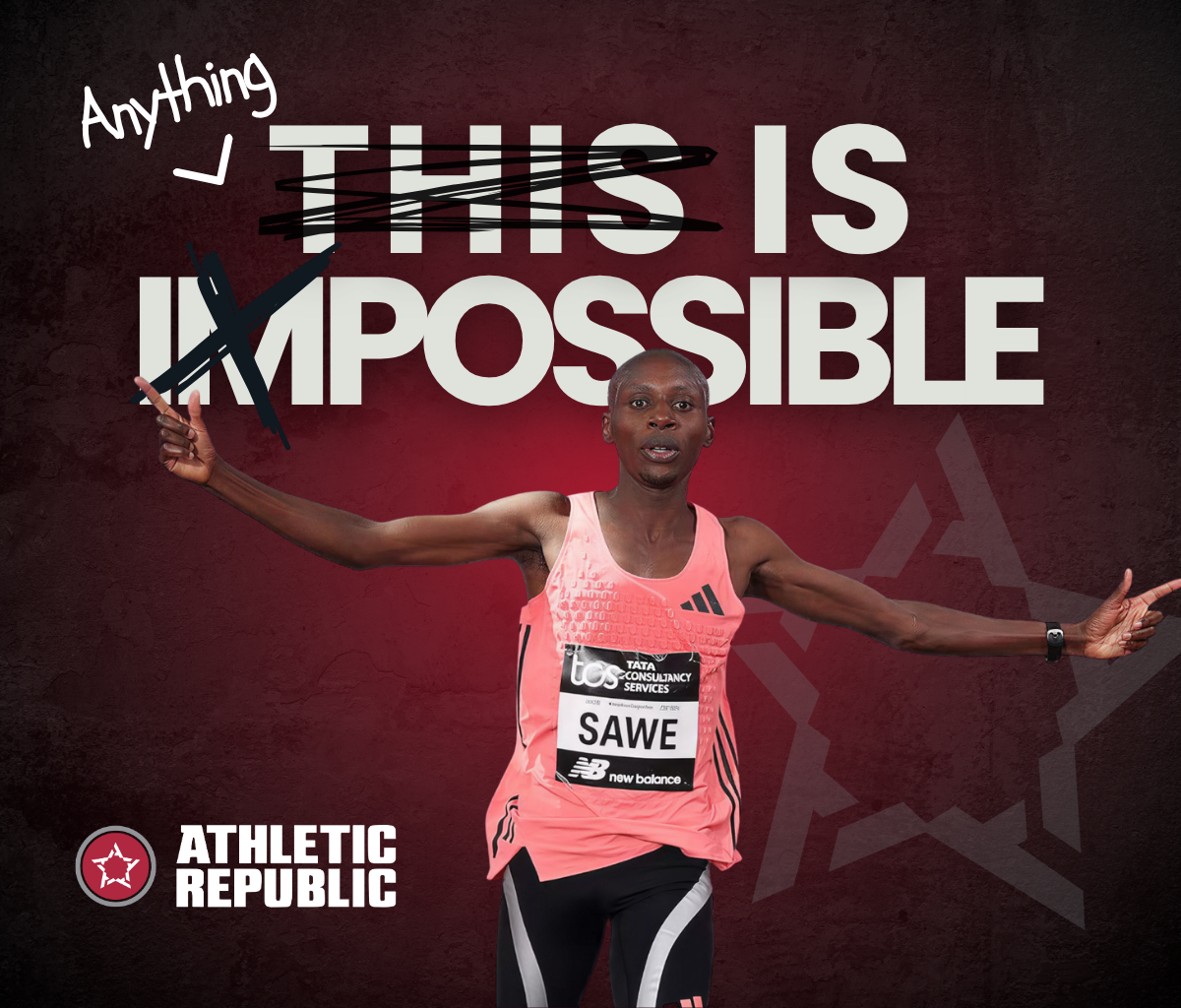
On Sunday, a 31-year-old man named Sabastian Sawe ran 26.2 miles in 1 hour, 59 minutes, and 30 seconds.
The marathon’s two-hour barrier was supposed to be the last impossible number in distance running. Experts spent decades debating whether human physiology could even allow it. Yesterday in London with near perfect weather conditions, Sawe didn’t just answer the question. He obliterated it, by 65 seconds. And the runner behind him, Yomif Kejelcha, broke it too. On his first marathon ever.
This accomplishment is as big as Roger Bannister breaking the four-minute mile in 1954. Both were barriers that science said couldn’t be crossed until someone crossed them. And both changed what every runner after them believed was possible.
This moment didn’t come out of nowhere. The push toward a sub-two-hour marathon has been building for years. In 2017, Nike’s Breaking2 project put Eliud Kipchoge on a closed course in Italy with a team of pacers, laser-guided pacing, and optimized conditions. He ran 2:00:25—just seconds short.
Two years later, he returned in Vienna for the INEOS 1:59 Challenge. Under similarly controlled conditions, Kipchoge ran 1:59:40, becoming the first human to break two hours—though it didn’t count as an official world record due to the setup.
What those performances did count for was belief. They proved the barrier wasn’t theoretical. It was waiting.
That’s what makes what happened in London different. This wasn’t controlled. No rotating pacers. No experimental setup. Just a championship-style race—and two athletes breaking a barrier that once required a perfectly engineered environment.
Even more remarkable, the depth of the field pushed the limits further. The top three finishers all ran faster than the previous world record, signaling not just one breakthrough performance—but a shift in the entire ceiling of the sport.
Yes, the Shoes Are Fast. He Still Had to Run It.
There’s already a conversation happening about technology. Sawe wore Adidas’ latest carbon-fiber supershoes, which weigh 99 grams – less than a bar of soap. Shoe technology has absolutely played a role in the progression of marathon times over the past decade.
But let’s be clear about something: no shoe runs the race for you.
Sawe covers about 200 kilometers a week in training. That’s roughly 125 miles. Every week. At altitude in Kenya. His coach, Italian trainer Claudio Berardelli, has built a program around progressive overload, strength work, recovery protocols, and patience. Sawe receives physiotherapy five to six times a week – not because he’s hurt, but because prevention is part of the plan.
The technology helps. The human does the work.
The Part Nobody’s Talking About
Here’s what makes Sawe’s story extraordinary beyond the finish time.
In March 2020, he ruptured a tendon. By August, he could barely jog. COVID shut down every race and travel opportunity. His family pressured him to quit running and take a job with the police. He was broke, injured, and stuck in a sport that had given him nothing.
He refused to stop.
His first international race more than two years later? He was hired as a pacemaker, not even a competitor, in a half marathon. His job was to lead the pack for the first 10 kilometers and then drop out. Instead, he kept running, dropped everyone, and won.
That was 2022. Four years later, he’s the fastest marathon runner in human history.
How Far Can You Go?
The real question Sawe’s run raises isn’t about shoes or split times. It’s simpler than that.
How far do you want to go?
Most of us aren’t trying to break world records. But every athlete, from our youth athletes training in our centers to the adult working through a personal fitness goal, hits a wall at some point. A moment where the body says stop and the mind has to decide what happens next.
What separates the people who break through from the people who don’t usually isn’t talent. It’s preparation. It’s having the right training. It’s building a body that can handle the stress. And when injury or setback happens, because it does, it’s having the foundation to come back stronger.
That’s what we do at Athletic Republic. Not at the world-record level. But at the level that matters to you.
Our training programs are built around the same principles that show up in every elite story like Sawe’s: progressive training loads, sport-specific conditioning, and injury prevention. Programs like our ACL Bridge exist specifically because we know that the biggest threat to any athlete’s potential isn’t a lack of talent. It’s an injury that takes them out of the game.
Sawe ruptured a tendon and spent two years getting back. With the right training environment, the goal is to make sure that setback never happens in the first place, or if it does, that the athlete has the strength and structure to come back.
The Barrier is Gone. Now What?
After Bannister broke four minutes, dozens of runners followed within a few years and an estimated 2,000 plus to this day. The barrier was never physical. It was psychological.
Yesterday in London, two men ran under two hours. Sawe’s own coach says he hasn’t peaked yet. He’s only run four marathons in his career. He thinks 1:58 is possible.
Somewhere today, a young athlete is watching the replay and thinking: I want to do something like that.
The question isn’t whether they have what it takes. The question is whether they’ll get the training, the support, and the patience to find out.
That’s the part we can help with.
Athletic Republic has been training athletes of all ages and abilities for over 30 years. If you’re ready to find out how far you can go, find your nearest location and schedule a trial.
Citations
https://www.bbc.com/sport/athletics/articles/cn898pn2x08o
https://www.bbc.com/sport/athletics/articles/cp383n09030o#:~:text=To%20benefit%20from%20those%20statistics,sped%20up%20towards%20the%20finish.
https://www.runnersworld.com/uk/training/a43781904/claudio-berardelli/
https://en.wikipedia.org/wiki/Sabastian_Sawe#:~:text=However%2C%20in%20March%202020%20he,he%20failed%20a%20Covid%20test.
https://www.youtube.com/watch?v=VlxtY_9WWTo